




Crankshaft Runout Explained | M8 & Twin Cam Runout Specs
Posted by TMF Cycles on Aug 25th 2026
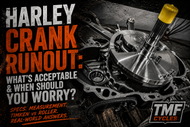
Harley Crankshaft Runout: What's Acceptable and When Should You Worry?
Pull the cam chest apart on a Harley and put a dial indicator on the pinion shaft.
The needle moves .001".
Nobody worries.
.002"?
Still looking pretty damn good.
.004"?
Now everybody has an opinion.
.008"?
Somebody is going to tell you Harley says it's fine.
And technically, depending on the engine and how it's being measured, they may be right.
But there's a huge difference between:
“Harley says it's still serviceable.”
and:
“This is the crankshaft we want underneath a serious performance engine.”
Those are not the same standard.
At TMF Cycles, crankshaft runout is something we pay attention to anytime we're getting deeper into a Harley performance build, especially when we're changing the cam plate, oil pump, cam drive or building a larger-displacement engine.
The number matters.
But just like CFM, oil pressure and half the other numbers people argue about with these engines, the number needs context.
What Is Crankshaft Runout?
In a perfect world, the crankshaft would rotate perfectly around its centerline.
Put a dial indicator against the pinion shaft and rotate the engine and the needle wouldn't move.
Real parts aren't perfect.
Runout is the amount the shaft moves away from that ideal centerline as the crankshaft rotates.
We're typically measuring Total Indicator Reading — TIR.
So if the dial indicator moves through a total range of .002", we're looking at .002" TIR.
The important part is that we're not just measuring whether the shaft itself is bent.
On a Harley pressed-together flywheel assembly, runout can also tell us something about the relationship between the flywheels, crankpin and shafts.
That's why crank runout gets our attention.
Harley Allows More Than Most Performance Builders Want
Here's where people get confused.
On a modern Milwaukee-Eight, Harley's service information allows as much as:
.012" runout measured with the shaft in the crankcase.
Read that again.
Twelve thousandths.
Harley also specifies a .005" service wear limit when the flywheel assembly is measured in a truing stand.
Those are Harley service limits.
That doesn't mean we're building a performance motor and saying:
“Sweet. It's only got .010". Send it.”
No.
A manufacturer's service wear limit answers a different question:
Has this component exceeded the point at which Harley says it should be replaced?
We're asking:
Is this the foundation we want underneath the engine we're about to build?
Very different question.
Service Limit Doesn't Mean Performance Target
This distinction matters.
If Harley says an assembled engine can have .012" shaft runout before exceeding the service wear limit, that doesn't mean .011" is somehow ideal.
Think about any other wear specification.
If a cylinder has a maximum allowable taper, you don't intentionally machine a fresh cylinder right up to that limit.
If a piston has a maximum wear clearance, you don't build a fresh motor there.
A service limit is the edge of what's considered reusable.
It isn't necessarily the number we're shooting for when building an engine.
Runout should be viewed the same way.
The Old Timken Bottom Ends Were Different
This is where Harley history matters.
The earlier Twin Cam bottom ends used a Timken bearing arrangement on the left/primary side of the crankshaft.
Those engines had a more positively located crankshaft on that side.
And Harley's allowable runout numbers reflected a much tighter system.
The commonly referenced Harley service wear limit for those Timken-equipped Twin Cam engines was around:
.003"
Compare that with the numbers associated with the later bearing arrangement and you can see why older Harley builders sometimes look at modern runout specifications like they're insane.
They're used to an engine where three thousandths was getting to the service limit.
Now we're talking about Harley allowing substantially more movement on later engines.
Then Harley Changed the Main Bearing Arrangement
Harley eventually moved away from the Timken-style left-side main bearing arrangement.
Later Twin Cams and the Milwaukee-Eight use a different roller-bearing arrangement.
That changed how the crankshaft is supported and located in the cases.
And this is an important point:
Some movement you see at the end of the pinion shaft with the crank installed in the engine includes the effect of the complete bearing system.
That's one reason you have to know where and how a runout specification was measured before comparing numbers.
A crank measured between centers in a truing stand is not the same test as sticking a dial indicator on the end of the pinion shaft with the crank installed in the cases.
In-the-Case Runout vs Truing-Stand Runout
This causes a lot of confusion online.
Someone says:
“My crank has .004 runout.”
Okay.
Where did you measure it?
If we're indicating the pinion shaft with the crankshaft installed in the engine, we're measuring the entire assembled system.
If the flywheel assembly is removed and properly supported in a truing stand, we're measuring the crank assembly under a different condition and usually closer to the flywheels.
Those numbers cannot simply be treated as interchangeable.
That's why Harley can list something like:
.012" — shaft measured in case
and
.005" — measured in truing stand
for the same basic flywheel assembly service evaluation.
Whenever somebody gives you a runout number, the next question should be:
How was it measured?
Why Did Harley Go Away From the Timken Setup?
This gets turned into:
“Harley made the new engines cheaper and worse.”
There's more to the engineering than that.
The newer bearing system changes assembly, manufacturing and how the crankshaft is supported. Modern engines are also designed as an entire system around that bearing arrangement.
And plenty of stock Milwaukee-Eights run a lot of miles without the crankshaft falling out of them.
So we're not saying:
Timken = good, roller bearing = garbage.
What we are saying is that the two systems locate and support the crankshaft differently, and that matters when we're discussing runout.
Especially when we're no longer talking about a stock 107 cruising down the highway.
Performance Changes the Conversation
Take a completely stock Milwaukee-Eight.
Stock displacement.
Stock compression.
Stock RPM limit.
Stock cam.
Normal riding.
Now compare that with:
128 inches.
Higher compression.
Ported heads.
Larger throttle body.
Aggressive camshaft.
More RPM.
A lot more torque.
A lot more cylinder pressure.
We're asking considerably more from the crankshaft.
That doesn't automatically mean the stock crank is going to fail.
But it absolutely changes how interested we are in its condition before building around it.
If we're spending thousands of dollars building the top end, we want to know what's happening underneath it.
Why Excessive Runout Matters in the Cam Chest
The pinion shaft doesn't exist by itself.
It's driving components.
On a Milwaukee-Eight, the oil pump is driven from the crankshaft.
The cam drive is right there.
The cam support plate is supporting components around it.
Now imagine the end of that shaft orbiting instead of rotating nicely around its centerline.
The farther it moves, the more the surrounding components have to accommodate.
That's one reason crankshaft runout matters when installing a precision aftermarket oil pump or cam support plate.
And it ties directly into the oil-pump article we already talked about:
Tighter tolerance isn't automatically better if what you're bolting it around isn't straight.
Aftermarket Parts May Have Tighter Limits Than Harley
This is a huge one.
Just because Harley says the crankshaft is still within its service limit doesn't mean every aftermarket component is designed to tolerate that amount of runout.
For example, S&S specifies significantly tighter pinion-shaft runout limits for certain cam-drive and cam-support applications.
Some S&S Twin Cam gear-drive applications require .003" TIR or less.
That's nowhere near .012".
And this is exactly why we read the instructions for the parts we're actually installing.
You can't say:
“Harley says the crank is good.”
and automatically assume that means:
“This crank is acceptable for every aftermarket cam plate, pump or gear-drive system.”
Those are two completely different statements.
Gear-Drive Cams Make Runout Even More Important
This is especially obvious on Twin Cams running gear-drive cams.
A chain can tolerate a certain amount of movement and misalignment.
Two gears meshing together are much less forgiving.
If the pinion shaft is moving around, gear lash is changing as the engine rotates.
Too much runout can create:
Noise.
Improper gear mesh.
Accelerated wear.
And potentially much larger problems.
That's why manufacturers of gear-drive systems generally specify much tighter crankshaft-runout requirements than Harley's broad service limits.
Before installing gear-drive cams, measure the crank.
Don't assume.
Oil Pumps Don't Love a Crank Orbiting Around Either
Same basic problem.
The oil-pump rotors are being driven by the crankshaft.
We want the pump properly centered around that shaft.
That's why proper oil-pump alignment during installation matters.
Now throw excessive crankshaft runout into the equation.
The pump has to deal with that movement every revolution.
This is one reason we're not interested in installing an extremely tight, high-performance oiling system around a crankshaft without checking what the crank is doing first.
The more precise the components we're installing, the more interested we become in the foundation they're being installed around.
How Much Runout Do We Like?
This is where I'm going to separate Harley's specification from what we'd rather see.
On a performance engine, less is better.
If we put an indicator on an M8 and see:
.001"
We're happy.
.002"
Still a nice-looking crank.
.003"
Now we're paying attention to the application, but that's still a completely different conversation than seeing .008" or .010".
Once the number starts climbing, we need to ask what we're building and what components we're planning to install.
There isn't one universal TMF number where every engine above it gets torn apart and every engine below it gets a green light.
The application matters.
But we're definitely not using Harley's .012" service limit as our performance target.
Not even close.
What About a Big-Inch M8?
This is where we'd become more critical.
If we're building a serious 128, 131, 135, 143 or larger engine, the crankshaft is part of the build whether we replaced it or not.
Higher displacement and cylinder pressure mean more load.
At some point, putting a huge top end on a questionable stock bottom end stops making sense.
If the crank is showing more runout than we're comfortable with, that may be the point where we discuss:
Truing the crank.
Balancing it.
Pinning or welding it depending on the crank and application.
Upgrading the connecting rods.
Changing the main-bearing arrangement where appropriate.
Or installing a purpose-built crankshaft assembly.
That decision needs to happen before we put the rest of the expensive engine together.
And This Is Where the Timken Conversion Comes Back Into the Conversation
For serious performance builds, you'll still see builders convert later bottom ends to a Timken-style left main-bearing arrangement.
The goal isn't nostalgia.
It's crankshaft control.
A properly set up Timken arrangement provides positive axial location and a very robust bearing system.
On a serious high-output build where the cases are already apart and we're addressing the crankshaft anyway, that can make sense.
But that doesn't mean every stock Milwaukee-Eight needs to be torn apart for a Timken conversion.
Again:
What's the application?
A mild cammed street bike and a 160+ horsepower big-bore engine aren't asking the bottom end to do the same job.
Don't Tear Apart a Good Bottom End Just Because the Indicator Moves
We don't want to take this too far the other direction either.
Put a dial indicator on almost anything and you'll find a number.
The goal isn't to scare somebody into rebuilding a perfectly healthy crankshaft because it has .0015" runout.
We're looking for information.
If we've got a healthy engine with low runout and the build isn't pushing the bottom end particularly hard, great.
Leave good parts alone.
But if the indicator is showing us something we don't like, we'd rather find it before installing the rest of the build.
That's why we measure.
Check It Before You Build Around It
This is really the whole point.
Crankshaft runout isn't something we check because we're hoping to find a problem.
We check it because we want to know what we're starting with.
Especially when we're installing:
A performance oil pump.
Aftermarket cam support plate.
Gear-drive cams.
A large cam.
Big-bore cylinders.
High-compression pistons.
Ported heads.
Or building an engine that's going to make serious torque and horsepower.
A dial indicator takes a few minutes.
Finding out the crankshaft was questionable after the engine is completely assembled costs considerably more.
Harley's Limit and Our Limit Don't Have to Be the Same
This is probably the most important takeaway.
Harley-Davidson can say:
.012" is the service wear limit with the shaft measured in the case.
That tells us something useful.
It tells us where Harley draws its serviceability line for that engine and measurement method.
It does not mean we're going to build a high-output engine around .011" runout because it's technically one thousandth inside the limit.
Our job isn't to see how close we can get to the service limit.
Our job is to decide whether the bottom end is appropriate for what we're asking the engine to do.
There's a big difference.
Build From the Bottom Up
At TMF Cycles, a performance engine isn't just pistons, heads and a camshaft.
The bottom end matters.
Crankshaft condition matters.
Runout matters.
Bearing support matters.
And the harder we're planning to push the engine, the more those things matter.
The older Timken-equipped engines had a different bearing arrangement and tighter runout expectations.
The newer roller-bearing engines are designed differently and Harley allows substantially more runout before reaching the published service wear limit.
That doesn't automatically make the newer design bad.
And it doesn't make .012" something we're excited to see.
It simply means we need to understand the difference between:
Factory serviceable.
and
What we want underneath a performance build.
Those are two very different standards.
Check the crank before you build around it.