






Harley-Davidson Diagnostic Trouble Codes (DTC)
Posted by TMF Cycles on Aug 20th 2026
Harley-Davidson Diagnostic Trouble Codes (DTC): Complete Guide & Code List
When the check-engine light comes on on your Harley-Davidson, the first step in diagnosing the problem is finding out which Diagnostic Trouble Code (DTC) the motorcycle has stored.
Modern Harley-Davidson motorcycles continuously monitor the engine management system and many of the motorcycle's electronic modules. When the ECM or another module detects a condition outside its expected operating range, it can store a diagnostic trouble code.
That code is an important starting point — but it isn't necessarily a diagnosis by itself.
At TMF Cycles, we use DTC information along with live sensor data, electrical testing and hands-on diagnostics to determine what is actually causing the problem.
This guide explains how Harley trouble codes work, how to retrieve them on many models, what the different code families mean, and some of the most common Harley-Davidson DTCs.
What Is a Harley-Davidson DTC?
DTC stands for Diagnostic Trouble Code.
A Harley's electronic modules monitor sensors, actuators, electrical circuits and communication between modules. When the system detects a fault, it can record a code identifying the circuit or system where the problem occurred.
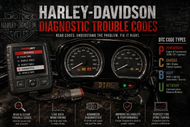
Harley trouble codes generally begin with one of four letters:
P — Powertrain
Typically associated with the ECM and engine-management system.
Examples include:
- Oxygen sensors
- Throttle position
- Electronic throttle control
- Injectors
- Ignition coils
- Crank position sensor
- MAP sensor
- Intake air temperature
- Engine temperature
- Fuel system
- ECM voltage
C — Chassis
Commonly associated with chassis systems such as ABS.
Examples include:
- Wheel-speed sensors
- ABS pump
- ABS valves
- ABS module
- Brake pressure sensors
B — Body
Typically associated with body and accessory electronics.
Depending on the model, these can involve:
- BCM
- Hand controls
- Lighting
- Security system
- Fuel-level system
- Radio/audio system
- Switch inputs
U — Network / Communication
U-codes indicate communication problems between electronic modules.
Examples include loss of communication with the:
- ECM
- BCM
- ABS
- Speedometer/instrument module
- Left-hand control module
- Right-hand control module
- Radio
A U-code can be particularly important because modern Harley-Davidson motorcycles use a network that allows multiple modules to communicate with each other.
A Trouble Code Doesn't Automatically Mean the Part Is Bad
This is one of the most important things to understand when diagnosing a Harley.
If the motorcycle shows an oxygen-sensor code, that doesn't automatically mean it needs an oxygen sensor.
If it shows a throttle-position code, that doesn't automatically mean it needs a throttle body.
A DTC tells you what the motorcycle detected, not necessarily which component caused it.
For example, a sensor circuit code could potentially be caused by:
- Failed sensor
- Damaged wiring
- Loose connector
- Corroded terminal
- Poor ground
- Low system voltage
- Short to ground
- Short to voltage
- Open circuit
- Module communication problem
- Actual mechanical problem causing the sensor reading
Proper diagnosis starts with the code and then verifies the circuit or system responsible.
Current vs. Historic Harley Trouble Codes
Another important distinction is whether the code represents a problem that is happening right now or something that occurred previously.
A stored or historic DTC can remain in memory even though the condition that originally caused it is no longer present.
This is why simply reading every stored code and replacing parts can send you in the wrong direction.
For example, disconnecting components during repairs, having a weak battery, performing electrical work or operating the motorcycle with certain components disconnected can create stored DTCs.
When diagnosing a motorcycle, we want to know:
- What codes are present?
- Which module stored them?
- Are they current or historic?
- Can the fault be reproduced?
- What does live data show when the problem occurs?
That information is considerably more valuable than the code number alone.
How to Check Harley-Davidson Trouble Codes
The exact procedure varies by motorcycle generation and instrument configuration.
On many Harley-Davidson models equipped with the traditional odometer/trip-button diagnostic system, the basic procedure is:
- Set the Run/Stop switch to RUN.
- Turn the ignition OFF.
- Press and hold the odometer/trip reset button.
- Turn the ignition to IGNITION while continuing to hold the button.
- Release the button when the motorcycle enters diagnostic mode.
- Use the trip/odometer button to move through the available diagnostic modules.
- Select the desired module to display stored DTCs.
- Record every code before clearing anything.
Depending on the model and year, the available modules and the way diagnostic information is displayed can be different.
Do not immediately clear the codes.
Write them down first.
The combination of codes stored in different modules can provide important information when diagnosing communication, voltage and electrical problems.
Understanding the Older PSSPt Diagnostic Display
Many Harley-Davidson motorcycles use the familiar:
PSSPt
diagnostic display.
The letters represent different modules or systems.
Depending on the motorcycle, these can include:
P — ECM/ICM
Electronic Control Module or Ignition Control Module.
S — TSM/TSSM/HFSM
Turn Signal Module, security module or Hands-Free Security Module depending on the motorcycle.
SP — Speedometer
Instrument/speedometer diagnostics.
T — Tachometer
Tachometer diagnostics where equipped.
Not every motorcycle will respond to every selection.
A motorcycle without a particular module may display "No Rsp", meaning there is no response from that module.
Common Harley-Davidson ECM / Powertrain Codes
Here are several codes Harley owners and technicians commonly encounter.
P0107 — MAP Sensor Low/Open
The ECM is seeing an unexpectedly low MAP sensor signal or an electrical fault in the MAP circuit.
Possible areas to inspect include the MAP sensor, wiring, connector, reference voltage and sensor ground.
P0108 — MAP Sensor High/Open
MAP sensor signal is above the expected range.
Check the MAP circuit, connector, sensor and related wiring before condemning the sensor.
P0112 — Intake Air Temperature Sensor Low
Indicates a low-voltage condition in the intake-air-temperature sensor circuit.
P0113 — Intake Air Temperature Sensor High/Open
Usually indicates the IAT circuit is reading excessively high voltage or has an open circuit.
P0131 — Front Oxygen Sensor Low
Front-cylinder oxygen-sensor signal is low.
This can involve the sensor or circuit, but the actual engine operating condition should also be investigated.
P0132 — Front Oxygen Sensor High
Front O2 sensor signal is high.
P0134 — Front Oxygen Sensor Inactive
The ECM is not seeing the expected activity from the front oxygen sensor.
P0151 — Rear Oxygen Sensor Low
Rear-cylinder oxygen-sensor signal is low.
P0152 — Rear Oxygen Sensor High
Rear O2 sensor signal is high.
P0154 — Rear Oxygen Sensor Inactive
The ECM is not seeing expected rear oxygen-sensor activity.
P0261 / P0262 — Front Injector Circuit
These codes indicate an electrical problem involving the front fuel-injector circuit.
P0263 / P0264 / P0265 — Rear Injector Circuit
These codes involve the rear fuel-injector circuit.
P0371 / P0373 / P0374 — Crank Position Sensor / CKP
These codes involve the crankshaft-position signal.
Because the CKP signal is critical for ignition and injection timing, CKP faults can potentially create starting, stalling or running problems.
P0501 / P0502 / P0503 — Vehicle Speed Sensor
These codes indicate faults involving vehicle-speed information.
Depending on the motorcycle, speed information can also be shared between modules, making proper diagnosis important before replacing the speed sensor.
P0562 — System Voltage Low
The ECM has detected low electrical-system voltage.
Before chasing unrelated electronic faults, inspect:
- Battery condition
- Battery terminals
- Grounds
- Charging system
- Main power connections
Low voltage can cause multiple modules to generate codes at the same time.
P0563 — System Voltage High
The ECM has detected excessive system voltage.
Charging-system output should be checked.
P0603 — ECM EEPROM Memory Error
An ECM memory-related fault has been detected.
P0605 — ECM Flash Memory Error
The ECM has detected a flash-memory problem.
P0641 / P0651 — 5-Volt Reference Circuit
Modern Harley sensors commonly rely on regulated reference-voltage circuits.
A shorted sensor or wiring problem on a shared 5V reference can affect several sensors at once.
This is a good example of why replacing the component named by the first DTC isn't always the correct repair.
Harley Electronic Throttle Control Codes
Throttle-by-wire Harley-Davidson motorcycles have additional monitoring for the throttle grip, throttle-position sensors and throttle actuator.
Common ETC-related codes include:
P1510 — EFI Limited Performance Mode
P1511 — EFI Power Management Mode
P1512 — EFI Forced Idle Mode
P1514 — ETC Air Flow Fault
P2100 — Throttle Actuator Motor Circuit Open
P2101 — Throttle Actuator Range/Performance
P2102 — Throttle Actuator Circuit Low
P2103 — Throttle Actuator Circuit High
P2105 — Forced Engine Shutdown
P2119 — Throttle Body Range/Performance
P2122 / P2123 — Twist Grip Sensor 1
P2127 / P2128 — Twist Grip Sensor 2
P2135 — Throttle Position Sensor Correlation
P2138 — Twist Grip Sensor Correlation
P2176 — Closed Throttle Position Not Learned
Electronic throttle systems use redundant sensors so the ECM can compare signals and identify conditions where throttle position cannot be reliably determined.
A throttle-related code therefore needs to be diagnosed carefully rather than immediately assuming the throttle body itself has failed.
Harley Misfire and Ignition Codes
Common ignition and combustion codes include:
P1351 — Front Ignition Coil Driver Open/Low
P1352 — Front Ignition Coil Driver High/Shorted
P1353 — Front Cylinder No Combustion
P1354 — Rear Ignition Coil Driver Open/Low
P1355 — Rear Ignition Coil Driver High/Shorted
P1356 — Rear Cylinder No Combustion
P1357 — Front Cylinder Combustion Intermittent
P1358 — Rear Cylinder Combustion Intermittent
A combustion or misfire-related code doesn't necessarily mean the ignition coil is bad.
A cylinder that isn't contributing correctly can potentially involve:
- Spark
- Fuel
- Injector operation
- Compression
- Valve sealing
- Wiring
- Mechanical engine condition
This is another situation where proper testing matters.
Harley ABS Trouble Codes
C-codes commonly relate to the ABS system.
Examples include:
C0562 — ABS Voltage Low
C0563 — ABS Voltage High
C1021 — Front Wheel Speed Always Zero
C1023 — Rear Wheel Speed Always Zero
C1025 — Front Wheel Speed Intermittent
C1027 — Rear Wheel Speed Intermittent
C1029 — Wheel Speed Difference Too High
C1032 — Front Wheel Speed Circuit Fault
C1034 — Rear Wheel Speed Circuit Fault
C1040 — ABS Pump/Motor Error
Wheel-speed faults should be diagnosed rather than automatically treated as failed sensors.
Sensor wiring, connectors, sensor mounting, wheel-speed targets and communication with other modules can all be relevant depending on the motorcycle.
Harley BCM and Body Codes
Later Harley-Davidson motorcycles use a Body Control Module to manage many electrical functions.
B-codes can involve systems including:
- Fuel pump output
- Starter output
- Headlight
- Turn signals
- Brake lights
- Run/stop switch
- Ignition switch
- Neutral switch
- Clutch switch
- Bank-angle sensor
- Security system
- Hand controls
For example:
B2116 — Fuel Pump Output Open
B2117 — Fuel Pump Output Shorted High
B2118 — Fuel Pump Output Shorted Low
B2119 — Fuel Pump Output Overloaded
B2121 — Starter Output Open
B2122 — Starter Output Shorted High
B2123 — Starter Output Shorted Low
B2124 — Starter Output Overloaded
B2270 — BCM Internal Error
B2271 — BCM Voltage Low
B2272 — BCM/Instrument Module Voltage High
These codes are particularly useful when diagnosing motorcycles with intermittent electrical problems.
Harley CAN-Bus and Communication Codes
Modern Harley-Davidson motorcycles rely heavily on communication between modules.
Communication faults generally appear as U-codes.
Common examples include:
U0001 — CAN Bus Error
U0002 — CAN Communication Bus Performance Error
U0100 — Lost Communication With ECM
U0121 — Lost Communication With ABS
U0140 — Lost Communication With BCM
U0141 — Lost Communication With LHCM
U0142 — Lost Communication With RHCM
U0156 — Lost Communication With Speedometer
U0184 — Lost Communication With Radio
If several U-codes appear at once, don't assume that several modules failed simultaneously.
The actual problem could potentially involve power, ground, CAN wiring, a connector or one module disrupting communication on the network.
Common Harley Diagnostic Abbreviations
When working with Harley diagnostic information, you'll commonly see:
ABS — Anti-Lock Braking System
BCM — Body Control Module
CAN — Controller Area Network
CKP — Crank Position Sensor
DLC — Data Link Connector
DTC — Diagnostic Trouble Code
ECM — Electronic Control Module
ECT/ET — Engine Temperature
EFI — Electronic Fuel Injection
FI — Fuel Injector
HO2S — Heated Oxygen Sensor
IAC — Idle Air Control
IAT — Intake Air Temperature
IMAP/TMAP — Combined manifold-pressure and temperature sensor
MAP — Manifold Absolute Pressure
TCA — Throttle Control Actuator
TGS — Twist Grip Sensor
TPS — Throttle Position Sensor
TSM/TSSM — Turn Signal / Turn Signal Security Module
VE — Volumetric Efficiency
VIN — Vehicle Identification Number
VSS — Vehicle Speed Sensor
WSS — Wheel Speed Sensor
Why Low Voltage Creates So Many Harley Trouble Codes
One of the first things worth checking when a Harley suddenly shows numerous unrelated trouble codes is battery and charging-system voltage.
Modern motorcycles contain multiple electronic modules communicating with each other.
If system voltage drops too far, modules can reset, sensors can produce abnormal readings and communication between modules can be interrupted.
The result can be a collection of seemingly unrelated:
- P-codes
- B-codes
- U-codes
- ABS codes
Before assuming the motorcycle suddenly has five separate failures, verify the electrical foundation first.
Check the battery, terminals, grounds and charging system.
Don't Clear Codes Before Recording Them
If you're diagnosing a problem, write down or photograph every code before clearing anything.
The stored information may be your best clue to what happened.
This is particularly important with intermittent problems.
Once the codes are recorded, they can be cleared and the motorcycle can be operated again to determine which faults return.
A code that immediately returns deserves much more attention than an old code created months ago when a connector was temporarily unplugged.
Complete Harley-Davidson DTC Reference
Harley-Davidson has used a large number of DTCs across different generations and models.
Not every code applies to every motorcycle.
The exact diagnostic definition and troubleshooting procedure should always be verified for the year, model, ECM and electronic system installed on the motorcycle.
This is especially important because Harley's electrical architecture has changed considerably between older EFI motorcycles, CAN-bus motorcycles, Milwaukee-Eight models and newer generations.
Use a trouble-code list as a diagnostic starting point — not a parts-replacement chart.
Harley Diagnostics at TMF Cycles
A check-engine light tells you the motorcycle detected a problem.
The DTC tells you where to start looking.
Neither one automatically tells you which part needs to be replaced.
At TMF Cycles, diagnostics can include code retrieval, live-data analysis, electrical testing and mechanical testing when necessary to determine the actual cause of the problem.
This becomes even more important on modified Harley-Davidson motorcycles where engine, intake, exhaust, injector, throttle-body and tuning changes can affect how the motorcycle operates.
Our approach is simple:
Diagnose the problem first. Replace parts second.
For Harley-Davidson performance, diagnostics, engine builds and professional dyno tuning, contact TMF Cycles.