






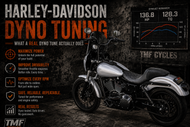
Harley-Davidson Dyno Tuning Explained | What a Real Dyno Tune Does
Posted by TMF Cycles on Aug 21st 2026
Harley-Davidson Dyno Tuning: What a Real Dyno Tune Actually Does
There’s a lot of confusion about what “tuning” a Harley actually means.
Load a map into a Power Vision? Tuned.
Run AutoTune for a few rides? Tuned.
Put the bike on a dyno, make three wide-open pulls and print the biggest horsepower number? Tuned.
Not really.
At TMF Cycles, when we dyno tune a Harley-Davidson, the goal isn't just to see how much horsepower it makes. The goal is to get the motorcycle properly calibrated for the combination that's actually in front of us.
That means getting the bike right where you actually ride it — not just at wide-open throttle.
Because your Harley spends a hell of a lot more time cruising at 2,500 RPM than it does bouncing off the rev limiter.
Every Build Is Different
This is probably the biggest thing people misunderstand about tuning.
You can have two Road Glides sitting next to each other with the same displacement, same cam and same exhaust and they still might not want exactly the same tune.
Now start changing things:
Camshaft.
Compression.
Cylinder heads.
Throttle body.
Injectors.
Intake.
Exhaust.
Displacement.
And the calibration the engine wants can change dramatically.
That's why we consider a supplied or canned calibration a starting point, not a finished product.
It gets us in the ballpark.
Then we tune the motorcycle that's actually sitting on the dyno.
A Dyno Isn't Just a Horsepower Machine
Everybody loves the horsepower pull.
We do too.
There's nothing wrong with wanting to know what your build makes.
But that's actually a pretty small part of what a chassis dyno is useful for.
Our Dynojet 250i has an eddy-current load control system. That allows us to put the motorcycle under controlled load and work in areas of the calibration that would be difficult, inconsistent or unsafe to hold on the street.
Instead of only going wide open from 2,500 to 6,000 RPM, we can actually work through the operating range.
Low throttle.
Part throttle.
Cruise.
Transition areas.
Higher load.
And eventually wide-open throttle.
That's where a lot of the actual tuning happens.
We Don't Start by Beating the Hell Out of It
Especially on a fresh engine build.
When a new build goes on our dyno, we're not immediately twisting it wide open to see what number pops up.
We start conservatively.
We want the motorcycle up to temperature. We want to make sure there aren't any leaks. We want to know oil pressure is good, the bike sounds right and nothing obvious is telling us to stop.
Then we start working through the lower-load areas of the calibration.
On a fresh build, we'll generally start down low — light throttle and lower RPM — and gradually work our way outward as the tune comes around and we're comfortable with what the engine is doing.
There is no reason to put a fresh, poorly calibrated engine under maximum load just because it's strapped to a dyno.
The dyno gives us control.
We use it.
VE Is a Huge Part of Getting the Bike Right
One of the biggest parts of tuning a modern Harley is getting the Volumetric Efficiency tables, or VE tables, correct.
You don't need to understand every piece of the math to understand why they matter.
Basically, the ECM needs an accurate model of how much air the engine is moving under different operating conditions.
Change the engine and you change that airflow.
A bigger cam can change it.
Cylinder heads can change it.
Compression can change how the engine behaves.
A throttle body can change it.
An exhaust can have a huge effect on it.
That's why we don't assume that because somebody else has the “same build,” their VE tables are automatically right for your motorcycle.
We actually measure what the bike is doing and correct the calibration.
And we don't just care about VE at wide-open throttle.
A bike can make a beautiful dyno pull and still ride like shit at 10% throttle.
Part-Throttle Tuning Matters
This is the part customers actually feel every day.
You pull away from a stop.
Roll through town.
Hold a steady speed on the freeway.
Pass a car.
Roll back into the throttle after a corner.
Those areas aren't represented by a single WOT dyno pull.
We spend time working through different throttle positions and RPM ranges because that's where drivability comes from.
A properly tuned bike should feel clean and predictable.
It shouldn't constantly surge.
It shouldn't feel lazy and loaded up when you crack the throttle.
It shouldn't have weird holes in the power delivery.
And it shouldn't only run well when the throttle is pinned.
Peak horsepower gets the screenshot.
Part-throttle tuning is what makes you enjoy riding the motorcycle.
Air/Fuel Ratio Is Only Part of the Tune
Another common misconception is:
“The AFR is good, so the tune is good.”
AFR matters.
A lot.
But AFR is not the entire calibration.
We also have to pay attention to how the motorcycle gets from one operating condition to another.
Idle.
Cruise.
Acceleration.
Deceleration.
Throttle transitions.
Engine temperature.
Load.
Electronic throttle behavior on applicable motorcycles.
And then there's ignition timing.
A motorcycle can have perfectly reasonable air/fuel numbers and still have a calibration that isn't right.
More Timing Doesn't Automatically Mean More Power
Ignition timing is an area where you can hurt parts trying to chase a number.
The idea that you simply keep adding timing until horsepower goes up isn't how we approach it.
An engine wants what it wants.
Compression ratio matters.
Combustion chamber design matters.
Cylinder pressure matters.
Fuel quality matters.
Temperature matters.
The cam matters.
Load matters.
Sometimes additional timing makes more power.
Sometimes it does almost nothing.
Sometimes the engine wants less.
And if you're getting into knock or detonation, you're heading in the wrong direction regardless of what somebody's timing table on the internet says.
We'd rather give the engine the timing it actually wants than chase another couple horsepower for a dyno sheet.
Knock Matters
Knock is something we're paying even more attention to as Harley performance builds continue getting more aggressive.
Big displacement.
Higher compression.
More cylinder pressure.
More load.
All of that makes proper calibration more important.
The factory ECM has its own knock-control strategies on applicable motorcycles, but we don't believe the answer is simply relying on the ECM to save an aggressive tune.
The goal is to build a calibration the engine is happy with in the first place.
That means looking at the entire combination instead of blindly copying timing from another motorcycle.
The Exhaust Can Completely Change the Tune
People sometimes underestimate how much the exhaust affects a Harley.
A pipe isn't just something that makes noise and moves exhaust gas out of the engine.
Exhaust design affects cylinder filling.
It affects scavenging.
It can create reversion.
And all of that shows up in the tune.
We've seen engines where airflow changes considerably through different RPM and throttle areas because of the exhaust combination.
That is another reason we don't like blindly smoothing tables just because a graph looks prettier afterward.
Sometimes an ugly-looking area is showing you something the engine is actually doing.
You have to understand why the numbers look the way they do before you start changing them.
A Dyno Sheet Doesn't Tell the Whole Story
Let's talk about the number.
Horsepower and torque are obviously important on a performance build.
If we build a motor, we want to know whether the combination works.
But the highest number on the screen doesn't automatically mean it's the best-running motorcycle.
We look at the curve.
Where does the torque come in?
Is there a big hole in the middle?
Does it carry power?
Is the combination doing what the customer wanted it to do?
A 150-horsepower motorcycle with a big hole in the torque curve can be less enjoyable on the street than another combination with a broad, hard-hitting torque curve.
The shape of the graph tells a story.
The peak number is just one part of it.
Dyno Numbers From Different Shops Aren't Always Apples to Apples
This deserves to be said too.
Don't get completely hung up comparing your dyno sheet to a screenshot somebody posted online.
Different dynos can read differently.
Correction factors matter.
Weather conditions matter.
How the test is performed matters.
Even setup details can affect the final number.
That's why we're more interested in whether the combination is performing the way it should than trying to win an internet dyno competition.
If we're testing changes on the same motorcycle, on the same dyno, under controlled conditions, the comparison becomes much more useful.
AutoTune Is Useful — But It Isn't the Same Thing
We use modern tuning tools and data collection because they're extremely useful.
AutoTune can be useful.
Data logging is useful.
Wideband oxygen sensors are useful.
But none of those automatically replace understanding what the engine is doing.
A system can recommend VE changes.
It can't look at the whole build and tell you that the weird area in the map is probably reversion from the exhaust.
It can't hear a mechanical problem developing.
It can't decide that the bike needs to come off the dyno because something doesn't sound right.
And it doesn't know what you're trying to accomplish with the motorcycle.
The tools give us information.
We still have to make decisions with it.
A Canned Map Isn't a Bad Thing
We don't want this to come across like every base calibration is garbage.
It isn't.
A good base map can save a lot of time.
If the displacement, injectors, throttle body, cam and other major components are reasonably close, a good starting calibration gets us much closer than starting from scratch.
That's exactly what we want.
But it's still a base map.
The next step is making that calibration match the actual engine.
That's the difference.
Big Builds Make Proper Tuning Even More Important
The farther you move away from stock, the less comfortable we are with assuming a generic calibration is “good enough.”
A stock-displacement motorcycle with an air cleaner and exhaust is one thing.
A 128-inch M8 with higher compression, ported heads, a larger throttle body, larger injectors, a big cam and a performance exhaust is something else entirely.
You have a lot of money sitting between your legs.
Tuning shouldn't be the place where you decide to guess.
And on a serious engine, we're not only looking for power.
We're looking for consistency.
Drivability.
Temperature.
Fueling.
Timing.
Throttle response.
And whether the combination is actually working together.
What Does a Finished TMF Dyno Tune Feel Like?
Ideally?
You shouldn't be thinking about the tune.
The motorcycle should start.
Idle.
Take throttle cleanly.
Cruise without doing anything stupid.
Pull cleanly through the RPM range.
And make the power the combination is capable of making.
It should just feel right.
That's what we're after.
Not a motorcycle that only looks good on a dyno sheet.
Built First. Tuned to Match.
At TMF Cycles, we build Harley-Davidson performance motorcycles and tune them on our Dynojet 250i chassis dyno.
From cam-and-pipe combinations to high-compression Milwaukee-Eight big-bore builds, our approach is the same:
Tune the motorcycle that's actually in front of us.
Not somebody else's bike.
Not a dyno sheet from Facebook.
Not just the cells that make the biggest horsepower number.
The whole motorcycle.
Because horsepower is easy to talk about.
Making the entire combination work is the job.