






Milwaukee-Eight Oil Pump Upgrade: Do You Really Need One?
Posted by TMF Cycles on Aug 21st 2026
Do You Really Need an Upgraded Oil Pump in a Milwaukee-Eight?
Open up Facebook or a Harley forum and ask what you should replace while doing a Milwaukee-Eight cam and you'll probably hear the same thing:
“Put an oil pump and cam plate in it while you're there.”
Usually followed by:
“Get the biggest one.”
S&S.
Feuling.
Feuling Race Series.
Whatever makes the most pressure and moves the most oil must be better, right?
Not necessarily.
At TMF Cycles, we're big believers in upgrading parts when the engine actually needs them. But we're not big believers in replacing good parts with race-oriented parts just because they're available.
An oiling system should match the engine it's feeding.
And there's a big difference between a stock-bottom-end M8 with a cam and a high-compression, big-bore performance engine being run hard.
First: Yes, the Milwaukee-Eight Has an Oil Pressure Relief Valve
There's sometimes confusion about this because the M8 oiling system isn't laid out exactly like the Twin Cam.
A Twin Cam uses a pressure-relief valve and spring in the cam support plate.
The Milwaukee-Eight still uses an oil-pressure relief system, but the pressure-relief valve and spring are incorporated into the oil pump itself.
That valve has an important job.
As engine speed increases, the pump is capable of moving more oil and building more pressure. The relief system limits excessive pressure by opening at a predetermined point and bypassing oil.
So oil pressure isn't simply:
Bigger pump = more pressure = better engine.
The system has to work together.
Pump volume.
Clearances.
Oil passages.
Pressure relief.
Scavenging.
Oil temperature.
Engine clearances.
They all matter.
The Stock M8 Oil Pump Isn't Automatically Junk
This is where the conversation usually goes sideways.
Early Milwaukee-Eight engines had legitimate oiling and wet-sumping concerns, and Harley revised the factory oil pump during M8 production.
Because of that history, “replace the M8 oil pump” became almost automatic advice anytime someone opened a cam chest.
But we're a long way from saying every factory M8 oil pump needs to go in the trash.
If we're working on a healthy later-model M8 with a good factory oiling system and we're installing a bolt-in cam, we're not automatically convinced that motorcycle needs a race oil pump.
What problem are we trying to solve?
That's the question.
If the answer is:
“I don't know. The internet said I needed one.”
That's not much of a reason.
More Oil Pressure Isn't Automatically Better
This is probably the biggest misconception.
People see an aftermarket pump advertised as producing more pressure and immediately assume that's an upgrade for every engine.
But an engine doesn't need the highest oil pressure you can possibly create.
It needs adequate oil pressure and volume for the engine's requirements.
There's a difference.
For example, Feuling advertises significantly increased oil pressure with some of its M8 oiling systems.
That's not inherently bad.
On the right engine, increased volume, improved scavenging and better pressure control can be exactly what we're looking for.
But that doesn't mean every stock-bottom-end M8 needs it.
We're trying to properly lubricate the engine.
We're not trying to win an oil-pressure contest.
Understand What a Race Series Pump Actually Is
This is another area where the name gets ignored.
Race Series.
That's telling you something.
Take Feuling's Race Series M8 pump as an example.
It's not simply a prettier version of the factory pump.
Feuling machines its Race Series pump from 7075 aluminum, uses tighter manufacturing tolerances and gives the Race Series pump deeper scavenge sections than its HP+ version.
The accompanying High Flow camplate also increases oil passage and reservoir capacity.
That's a serious performance oiling system.
And that's exactly why we don't look at it as an automatic requirement for every cammed Milwaukee-Eight.
If we're building a large-displacement, high-compression engine that's going to see high RPM and serious load, our requirements are different than a basically stock 114 with a bolt-in torque cam.
Use the part for the application it was designed for.
Pressure Relief Matters Too
The aftermarket pumps aren't necessarily calibrated exactly like one another either.
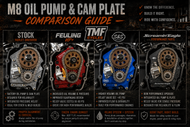
For example, S&S states that its Milwaukee-Eight oil pump pressure-relief valve is factory set to relieve at approximately 45 psi.
Feuling states that its M8 oil pumps are bench tested with the relief valve fully opening around 55–60 psi.
That's a pretty good illustration of why comparing oil pumps solely by saying:
“This one makes more pressure.”
doesn't tell the entire story.
Different manufacturers are making different decisions about oil volume, scavenging and pressure control.
The whole system needs to be considered.
Scavenging May Be More Important Than Chasing Pressure
The oil pump has two basic jobs that people sometimes lump together.
It has to supply oil to the engine.
And it has to get oil back out of the crankcase.
That second job is scavenging.
If oil accumulates in the crankcase faster than the pump can remove it, the rotating assembly starts fighting through that oil.
That's wet sumping.
And that's where a higher-capacity scavenge section can become extremely valuable.
This is one reason performance oil pumps aren't simply about increasing the number on an oil-pressure gauge.
A well-designed performance pump can improve the engine's ability to evacuate oil from the crankcase.
On a serious performance engine, that's something we care about.
When We Start Looking Harder at an Upgraded Pump
There isn't one magic horsepower number where the factory pump suddenly becomes unacceptable.
We look at the whole engine.
An aftermarket oiling system starts making more sense when we're dealing with things like:
- Large displacement
- High compression
- Increased engine RPM
- Aggressive performance use
- Increased engine temperature
- Known scavenging issues
- Wet-sumping problems
- An early M8 with an older oil-pump design
- Existing oil-pressure concerns
- A complete performance engine where we're already upgrading the entire cam chest
That's very different from saying:
“You installed a cam, therefore you need a race pump.”
A Cam Doesn't Automatically Require an Oil Pump
A camshaft changes valve timing.
Installing one doesn't magically increase the engine's oil requirement enough that every M8 suddenly needs the biggest aftermarket oil pump available.
If we're doing a relatively mild camshaft in an otherwise healthy later-model engine, there may be absolutely nothing wrong with retaining the factory oil pump and cam support plate.
That money might be better spent somewhere else in the build.
Good lifters.
Proper pushrods.
A quality cam bearing.
Better exhaust.
Proper tuning.
Whatever that particular motorcycle actually needs.
We'd rather spend a customer's money solving problems than creating a parts list because that's what everybody on Facebook says you're supposed to buy.
Installation Matters More Than People Realize
Here's another thing that doesn't get enough attention.
You can buy the best oil pump in the world and screw up the installation.
Both S&S and Feuling specifically instruct installers to properly center the M8 oil pump during installation.
The engine is rotated during the tightening procedure so the pump can center itself relative to the crankshaft.
Why?
Because you don't want the pump gears binding.
Feuling goes even further in its technical instructions, warning that improper camplate and oil-pump alignment can lead to premature wear or failure.
So when somebody says:
“I put a $500 race pump in it, so the oiling system is bulletproof.”
No.
The part still has to be installed correctly.
More precise parts make proper assembly more important, not less.
Crankshaft Runout Matters
This is also where the condition of the bottom end enters the conversation.
The oil pump is driven directly off the crankshaft.
If we're installing performance cam-chest components, we're going to pay attention to pinion-shaft runout.
S&S specifically instructs installers to measure pinion-shaft runout when installing its M8 cam support plate and recommends no more than .005-inch total indicated runout for its application.
That doesn't mean .005 is our personal target for every performance engine.
It means even the manufacturer of the aftermarket parts is telling you:
Check the crank before you start bolting precision parts around it.
That's something we agree with completely.
Tighter Isn't Automatically Better
This is probably the best way to explain our philosophy.
Performance parts are often manufactured with better materials and tighter tolerances.
That's great.
But tighter tolerance doesn't mean the part suddenly stops caring about the condition of everything around it.
Quite the opposite.
Crankshaft runout.
Pump alignment.
Camplate alignment.
Oil-passage alignment.
Seal condition.
Assembly procedure.
All become important.
If we're putting a precision race-oriented oiling system into an engine, we want to know what we're bolting it to.
We don't just throw expensive parts at an unknown bottom end and call it an upgrade.
So Should You Upgrade Your M8 Oil Pump?
Sometimes.
Absolutely.
We've got nothing against aftermarket oil pumps. We use performance oiling components when the build calls for them.
But here's the distinction:
We want a reason for the upgrade.
If we're building a serious big-bore M8 that's going to make a lot of cylinder pressure and spend time at high load and RPM, improved oil volume and scavenging make a lot of sense.
If we're correcting a known oiling problem, that makes sense.
If we're dealing with an early M8 oiling system, that's worth evaluating.
If the factory pump is damaged or worn, obviously we're replacing it.
But if you've got a healthy later-model Milwaukee-Eight and you're installing a mild cam?
We're not automatically going to tell you that you need the most aggressive race oiling system available.
We'll look at the motorcycle.
We'll look at the build.
We'll look at how it's going to be ridden.
And we'll choose parts accordingly.
Build the Engine as a System
This is really what it comes down to.
People love individual parts.
Biggest throttle body.
Biggest injectors.
Biggest cam.
Highest-volume oil pump.
But an engine doesn't know what the advertisement said.
It only knows whether all the parts work together.
At TMF Cycles, we'd rather build the combination correctly than install parts just because they're considered an “upgrade.”
Sometimes the right answer is an S&S or Feuling performance oiling system.
Sometimes the factory setup is perfectly capable of doing the job.
Knowing the difference is the important part.
Don't build from a checklist. Build for the application.